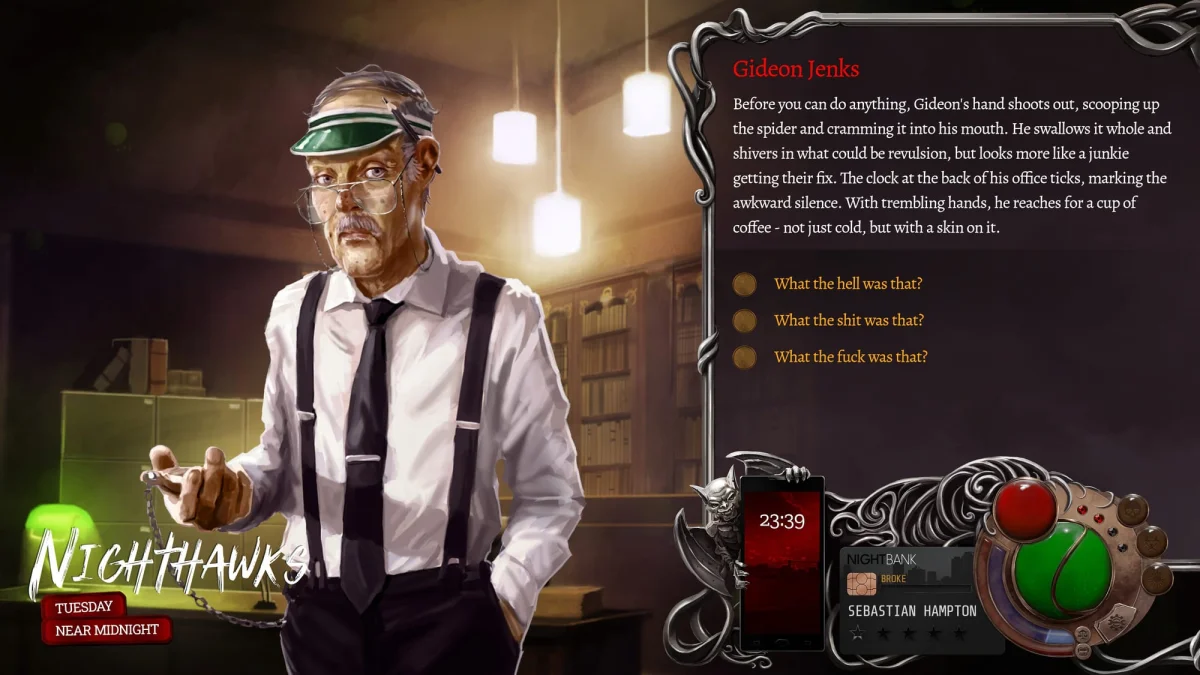
Nighthawks Review: A Vampire RPG Built on Nightly Schemes and Moral Choices
Wadjet Eye’s story-rich vampire RPG pairs a sprawling nocturnal city with sharp character writing, thorny feeding choices and occasional pacing stumbles.
Nighthawks finds a strong fit between its subject and its form. Wadjet Eye Games, known for point-and-click adventures such as Excavation of Hob’s Barrow (2022), takes a different route here: this is a story-led role-playing game built from written scenes, voice acting and illustration. That flexible presentation lets it follow a vampire through a city of competing interests, social traps and nightly routines, where the next useful move may be a conversation rather than a fight.
The result sits among the literary RPGs that include Roadwarden, Lovely Lady RPG, Citizen Sleeper and Thousand Hells. Like Disco Elysium, these games put character and writing at the center, while their more abstract presentation leaves room for varied scenes without requiring a fully simulated world. Nighthawks also draws on the work of Failbetter Games, especially Fallen London and Sunless Skies. Designer and writer Richard Cobbett worked on those games, and their influence shows in the mix of ornate writing, strange encounters and measured exploration.
A vampire’s city to work
Vampires are often cast as enemies to defeat. Nighthawks instead makes one the player character, with all the appetites and social complications that role brings. Its closest touchstone is Vampire: The Masquerade, where undead society runs on ambition, favors and long-running schemes. A vampire may create another to advance a personal plan; that new vampire can eventually develop ambitions of their own. The hierarchy keeps reproducing itself.
That kind of self-directed existence can be awkward to capture in games built around fixed objectives and tightly bounded spaces. Vampire: The Masquerade – Bloodlines approached it through an open-world immersive sim, an ambitious format with lasting appeal despite its flaws. Nighthawks sidesteps the need to model every corner of a city. Instead, its text and illustrations move freely between locations and situations, giving the player a broad nocturnal playground, several loose agendas and a clock that keeps advancing.
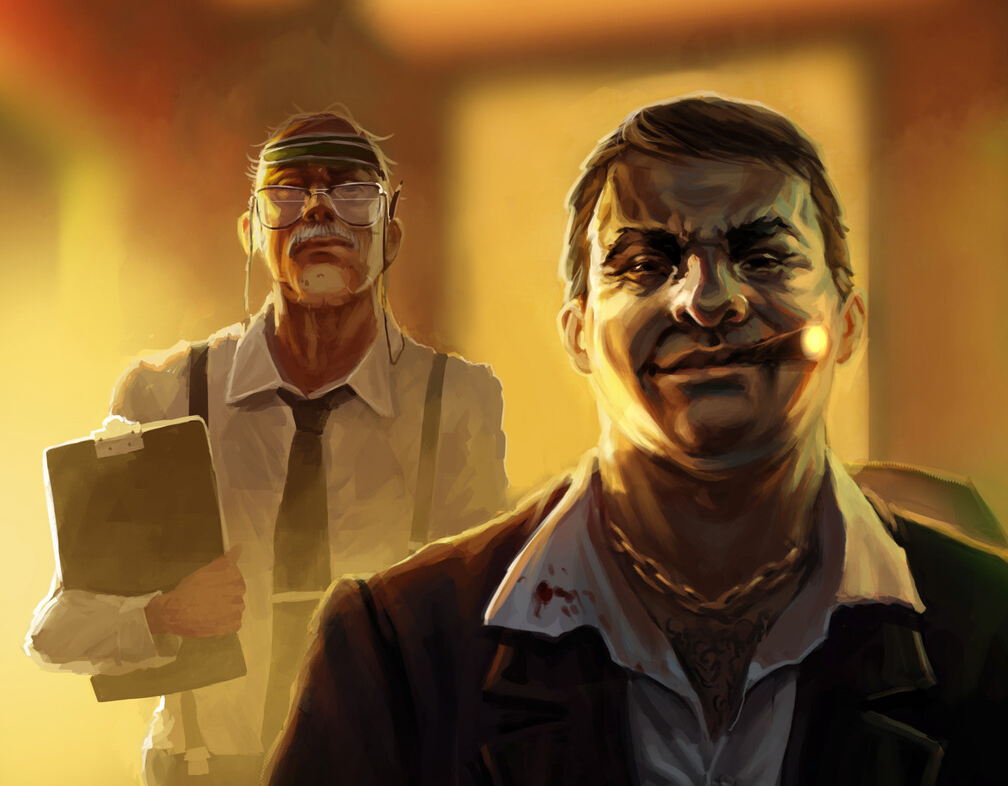
The city’s hidden world has already been exposed: people know vampires exist, but knowledge hasn’t brought acceptance. That shift gives the setting its own identity beyond the familiar vampire hierarchy. Masked human supremacists stalk the streets and condemn people who assist vampires, while wealthy elders can shelter behind their fortunes. Younger, poorer vampires have far less protection. The same revelation transforms the city into a more dangerous place to hunt, hide and build connections.
The game’s metaphors stay deliberately unsettled. Vampirism can suggest disease, sex, wealth, family, abuse or other forms of dependence, but the story doesn’t settle on a single reading. These vampires are predators, too. Their hunger isn’t merely symbolic, and the game tracks whether the player makes it through without taking blood without consent—a boundary that can be tested almost immediately.
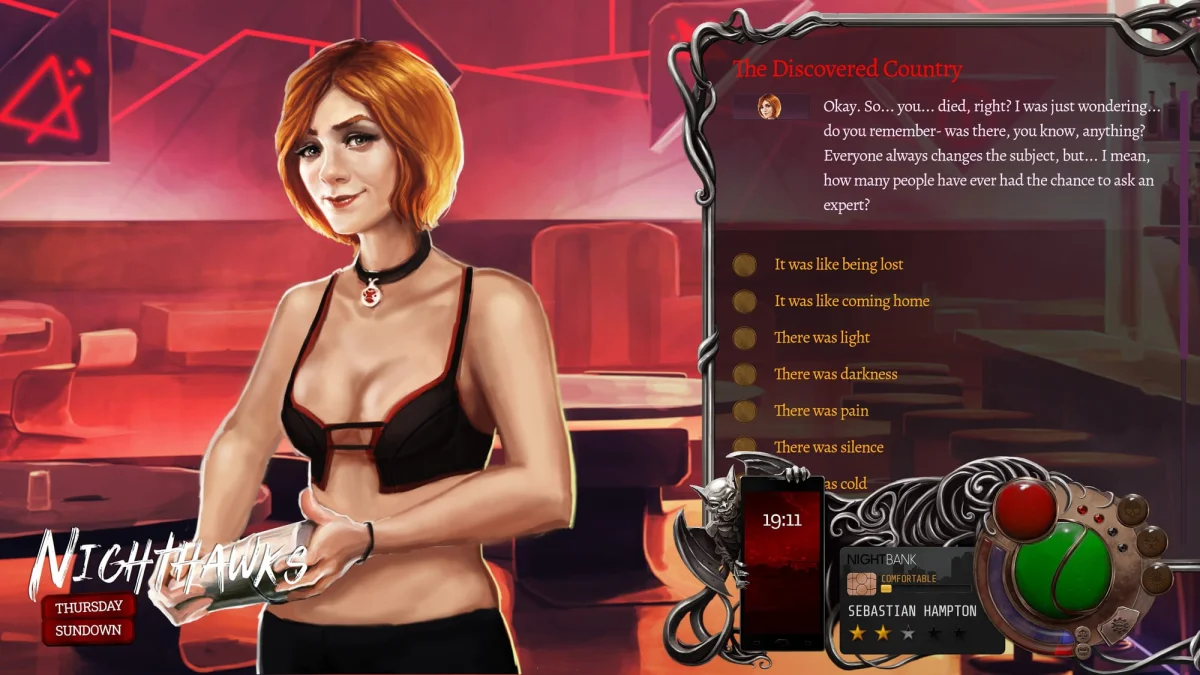
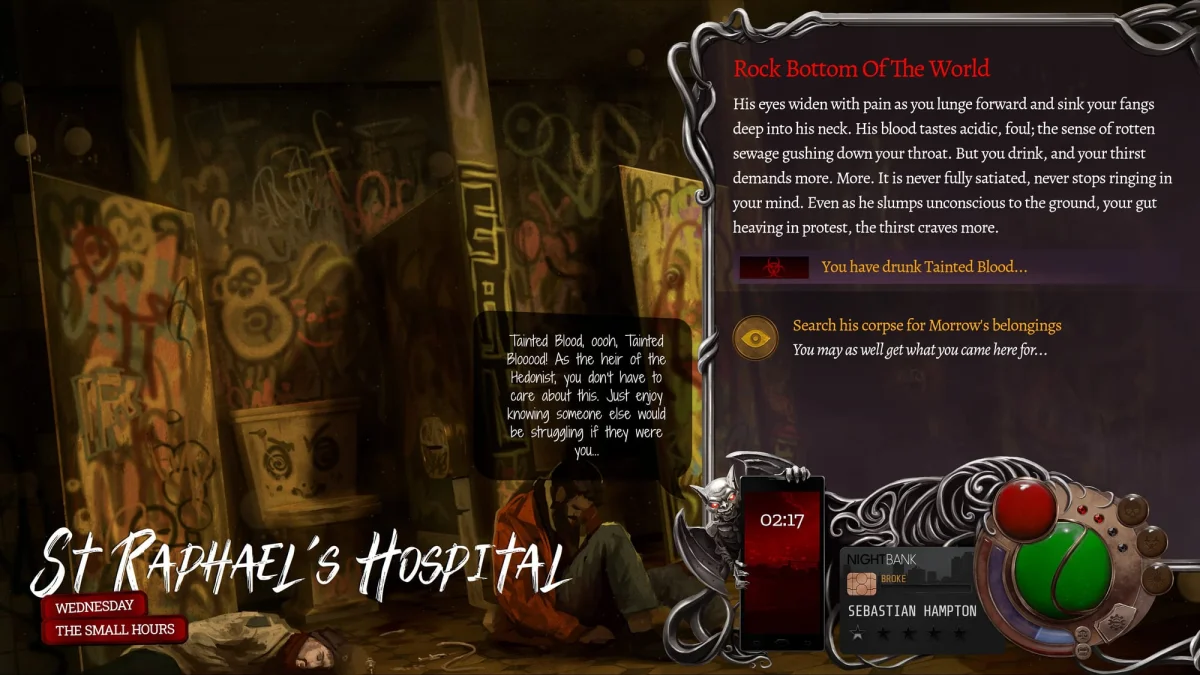
Feeding can happen opportunistically, through deliberate hunting, or with bottled blood supplied by a bartender. None of these routes makes the question of consent disappear: the person behind a bottle may have been desperate, coerced or already dead. The game makes predation part of both its mechanics and its fiction, and it keeps pressing on the uncomfortable idea of whether an exploitative system can ever offer an ethical way to take what it needs.
Choices, appetites and eccentric companions
Some mechanics land with a particularly dark sense of humor. Blood described as tainted can have an effect, but my character’s chosen immunity meant I never learned what it was. The game’s tooltip even told me I could ignore the system. That left certain risky-looking opportunities to feed as free meals for this character, provided I accepted draining someone for convenience. It’s an amusing mechanical loophole that also says something pointed about how differently vampires can respond to their condition.
Each character has their own way of living with the curse. Some are bored by immortality; others turn reckless or strange. The cast gives that premise room to breathe, even when it starts from familiar vampire archetypes. Agatha, for instance, is an immortal monster in a child’s body: a rude, thieving Victorian street urchin with an army of mesmerized rats. She feels closer to a particularly dangerous Fallen London character than a softened version of Anne Rice’s Claudia.
Agatha is also frequently hilarious. She can join the player on adventures, including visits to venues where a knife-wielding twelve-year-old is an unexpected guest. The companions don’t always receive equal attention: sometimes a story keeps them on the sidelines, while other sequences make them central. Still, they each bring a distinct presence, and taking them along adds another source of surprise to a city already full of unusual company.
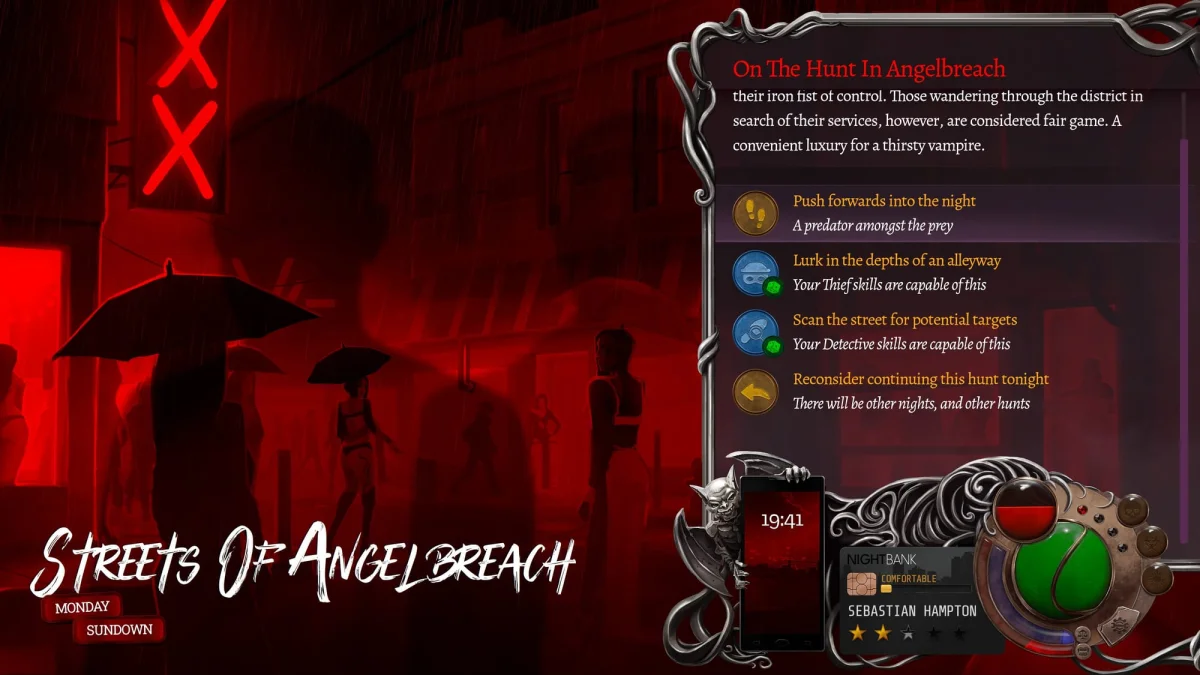
The city itself mixes Gothic horror, noir and cyberpunk. Mob bosses, trenchcoat detectives and vampires dressed for underground clubs or corporate offices share the same streets. The result makes the influence of Vampire: The Masquerade clear, while the world’s exposed vampires give the familiar imagery a different social tension.
Stories provide much of the game’s variety. Nighthawks feels more like an anthology than one tightly unified plot, with quests that shift between horror, comedy and character drama. Some cast the player as a potential victim; others turn them into an investigator, or leave them to face the consequences of being the monster. One memorable sequence recounts a family’s grim history under a vampire’s influence through an illustrated dollhouse, its rooms lighting up as the account unfolds.
That range suits the game’s presentation. A scene can change shape without the limits of a conventional action game, and the writing often uses those changes to make familiar places feel newly unsettling. A vampire’s perfume can be explained as cover for the scent of decay, then appear in a sexually charged scene whose illustration uses playing cards as clothing. The game puts its metaphors on display while leaving its characters free to be ridiculous, cruel or tender at the same time.
One more night
The city’s everyday rhythm provides the game with its quieter appeal. At the nightclub called Nighthawks, the player can find different characters, invite a companion along, ask about current concerns or overhear a conversation between two people who happen to be there. The bartender offers a rumor while pouring a glass of blood. Wandering can bring chance encounters, and major story sequences often serve as the payoff for a quest. Small changes in who is present make returning to familiar places feel worthwhile.
That routine creates a gentle pull to keep playing. There’s always another person to speak with, another place to check and another thread that might lead somewhere. The game’s many substantial stories build momentum gradually; a night can pass in what feels like a string of modest choices, until the player realizes how much time has gone by.
The pacing doesn’t always support that freedom. The calendar can feel sparse, and it isn’t always clear what the player should pursue next. I sometimes wandered without a way to advance the story I was following, then found that sleeping until the next day moved it along. More guidance about how the schedule shapes each thread would make the city easier to read.
There are occasional structural bumps, too: a story beat may arrive out of sequence, a scene can linger, or a choice’s consequences may be hard to predict. These moments sit alongside a large collection of carefully written stories, so they don’t define the experience, but they can blur the connection between a decision and its result. The game has enough strong material that these missteps feel like rough edges in an expansive narrative design.
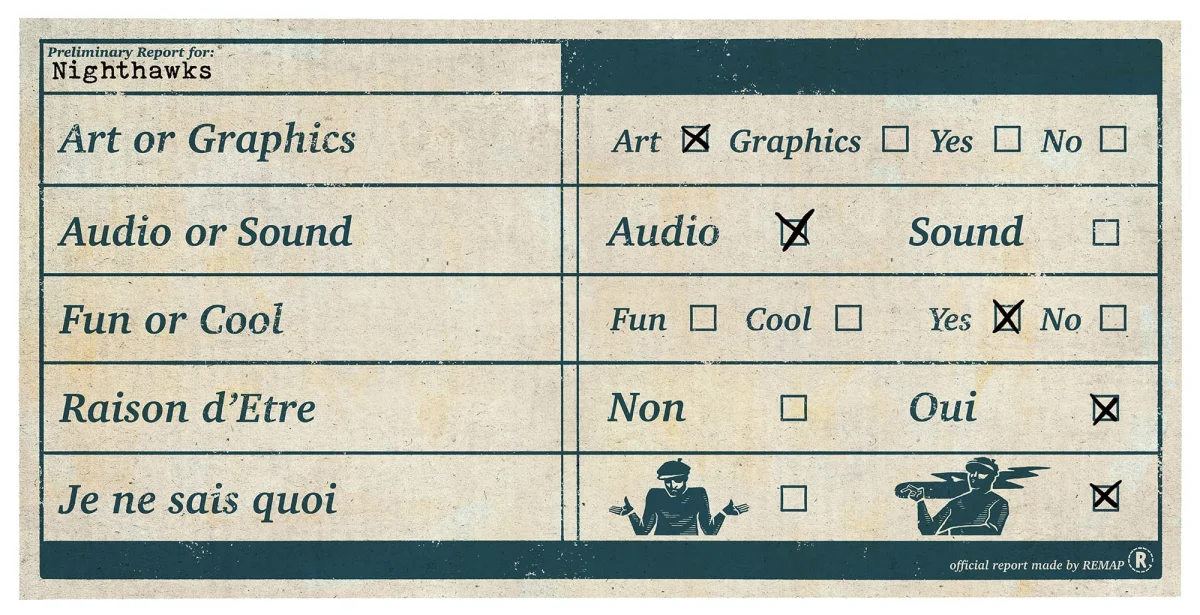
At its best, Nighthawks captures the particular pleasure of playing a vampire among other vampires: making plans, working a room and deciding what lines are worth keeping. Its smaller-scale scenes let it move between a blood-soaked moral problem and a strange joke without flattening either one. A gift of maggots for a vampire’s companion can be both humiliating and affectionate; an undead arm can retain its old limits, unless its owner is willing to break a wrist for a harder punch. The details make the characters feel lived in, even when they’re monsters.
Nighthawks is a sizeable collection of perspectives on vampire fiction, held together by a cast that’s fascinating, repellent and often funny. Its schedule and story structure could be clearer, but the writing, varied quests and nightly social routine offer a compelling reason to keep exploring. Players drawn to role-playing through voice and choice will find a city full of schemes—and plenty of uneasy reasons to stay for one more night.