Stellaris: Willpower Adds Ideological Expansion and Absolute Ethics
Willpower brings a nonviolent route to galactic growth, with Cultural Envoys, ideological revolts and new leaders. It arrives November 23 for $24.99 / £20.99.

Stellaris: Willpower gives players a new way to grow an empire: spread its beliefs across the galaxy, then turn that influence into political change. The expansion adds the Force of Will ambition, tools for converting other populations, and a new level of ethical commitment that can reshape an empire’s priorities. It’s designed for players who want ideological influence to drive a campaign, with conflict available as a fallback rather than the central plan.


Developed with Abrakam Entertainment, Willpower gives players a distinct route to victory in the 4X space game. Stellaris DLC Director Gary Morris says the team wanted an ambition that could support winning without making conflict the focus. That ambition, Force of Will, combines diplomacy with the natural spread of an empire’s beliefs. Players can still turn to war when they consider it necessary, but the expansion’s central systems reward influence and conversion.
Send envoys straight to other worlds
Force of Will runs on a new resource called Willpower. Players earn and spend it to unlock abilities and perks, including Cultural Envoys: ships that can cross closed borders and begin converting a planet’s population directly. Their ability to act without waiting for an empire’s influence to reach the target, or for diplomatic access to be secured, makes them an active instrument of ideological expansion.
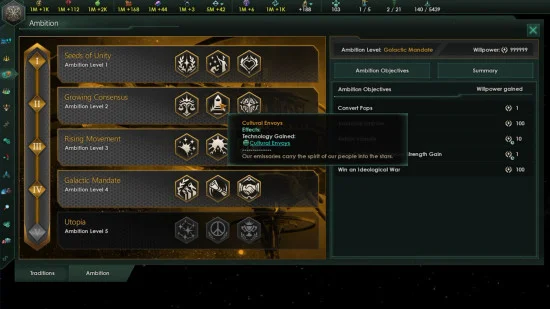
That direct approach sits alongside the ambition’s less forceful ways to spread an ethic. Together, the systems give players more control over how influence reaches another world: gradual spread and diplomacy can support the wider effort, while envoys offer a focused way to bring an ideology to a planet. The article describes the envoys as broadcasting ideas to the population below. How quickly that effort changes a planet’s politics will depend on the strength of the player’s ideological reach and the choices made through the expansion’s abilities.
Stellaris game designer Gabriel Brunet says Willpower puts more weight on soft power. Convert enough of a population, and its new beliefs can create unrest and ideological revolts. If a revolt succeeds, the resulting population may seek closer ties with an empire that shares its ideology, potentially becoming a vassal. That creates a chain of influence with a concrete payoff: conversion can unsettle a planet, and a successful revolt can open a path to expanding an empire’s network of dependent states.
Absolute ethics demand a tradeoff
Willpower also adds absolute ethics, a level of commitment beyond the existing fanatic ethics. Absolute ethics provide stronger effects and can add further modifiers, but reaching one costs three ethic points. Standard ethics use one point and fanatic ethics use two, so players pursuing an absolute ethic must give up one of their secondary ethics. That makes the choice a strategic trade: a more powerful expression of a core belief comes at the expense of some ideological breadth.
The cost also ties absolute ethics to the later stages of Force of Will. Players will need to decide whether that deeper commitment fits their empire’s direction, since dropping a secondary ethic changes which values it can represent. The system therefore connects the expansion’s victory ambition with empire building: the path to stronger ideological tools asks players to make their own society more focused.
Eight leaders reflect their ethics
Eight new paragon leaders are associated with specific ethics. After taking an ideology to the absolute level, players can build Galactic Halls and Galactic Cathedrals, which may attract one of these leaders to their empire. Narrative Content Designer Robert Brown describes the characters as embodiments of their associated ideals, giving the new buildings a chance to bring a distinctive personality into the empire’s leadership.
The examples span very different ways of serving a cause. One leader is a passionate functionary who advances an ideology through bureaucracy; a militarist leader is a warmonger whose physiology draws them toward battle. Those contrasts suggest the paragons are intended to express how an ethic shapes a character, rather than simply adding interchangeable bonuses. Their arrival also gives an empire that has committed fully to an ideology a possible new figurehead for that choice.

The expansion’s appeal will depend on how these pieces work together in play. Cultural Envoys make direct conversion possible across closed borders; ideological unrest can turn population change into revolt; and absolute ethics deepen an empire’s commitment while narrowing its range of values. That combination gives players several stages of influence to manage, from reaching a world to changing its beliefs and possibly drawing it into a wider political relationship.
Stellaris: Willpower releases Monday, November 23, for $24.99 / £20.99. It is also included in the Stellaris Season 10 bundle, priced at $49.49 / £41.59. The expansion arrives alongside the free Stellaris 4.6 update, Corona Borealis. For players interested in building power through ideology, the key question will be whether those conversion and revolt systems can carry an empire’s ambitions as effectively as fleets and conventional diplomacy.