Hearts of Iron 4 Romania DLC Adds New Economic and Historical Paths
The Romania focus pack adds choices around agriculture, industry and national direction, with distinct strategies for building strength before war.
Hearts of Iron 4’s upcoming Romania focus pack puts the country’s central challenge in the player’s hands: build on an agriculture-led economy, or push quickly toward industry while preparing for conflict. Its new focus paths also explore the strain of governing a country whose borders had recently expanded and whose regions had different histories and needs.

Paradox is developing the pack with modders Norrman, Marjin and Alex. Norrman says the team has played Hearts of Iron 4 since shortly after its release and has spent more than four years modding it. The result is designed to give Romania a wider set of options across its economy, internal priorities and relations with neighboring countries.
A country with competing priorities
At the 1936 starting point, Romania’s territory included communities of Hungarians, Bulgarians, Ukrainians and Russians, Norrman says. Holding that enlarged state together was a challenge in its own right. The country also faced potential threats on several fronts while trying to modernize an economy rooted in rural life and farming.
That mix gives the focus pack its strongest strategic tension. Industrial growth can improve Romania’s ability to prepare for war, but rapid investment may put pressure on people and economic stability in the short term. An agriculture-first approach offers a different trade: maintain the country’s established strengths, then build toward industry over a longer stretch.
Romania begins with regional alliances in its favor, including the Little Entente with Czechoslovakia and Yugoslavia, and the Balkan Pact, which also included Greece and Turkey. Those relationships give players a diplomatic starting point as they weigh internal development against the demands of a changing neighborhood. The broader appeal is flexibility: a run can focus on strengthening ties, building military capacity or reshaping the economy, with each choice affecting how quickly Romania can respond to danger.
Different routes through Romania’s history
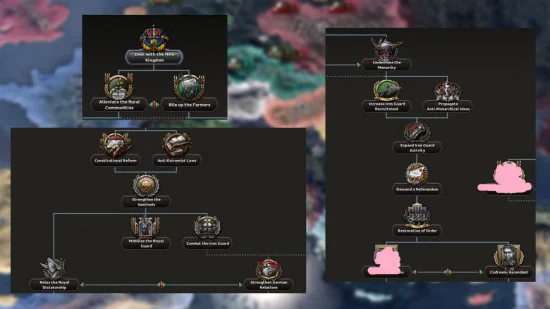
The historical path reflects Romania’s rapid shifts between four ideologies as the country responded to changing circumstances, according to Norrman. It also puts a longstanding regional divide at the heart of the tree: the “Old Kingdom,” associated with territory held before World War I, and the “New Kingdom,” formed from more recent acquisitions. Players will decide whether to prioritize established regions or direct more support toward newer ones.
An alternate route offers a sharper break with the existing monarchy. Players can expand the influence of the Iron Guard, described in the source as a revolutionary fascist faction, and pursue a change in the country’s leadership. That choice is expected to draw opposition from parts of Romania. The developers have also hinted at two possible directions from there, including one focused on building influence across the Balkans alongside ideologically aligned regions.
The branches give the focus pack room for both historically grounded play and alternate history. They also connect decisions about Romania’s internal makeup to the player’s wider strategy, rather than treating the country’s starting conditions as background detail. For players who enjoy longer campaigns, that can make the early choices feel consequential well before a major conflict begins.
Choose between faster industry and deeper farming
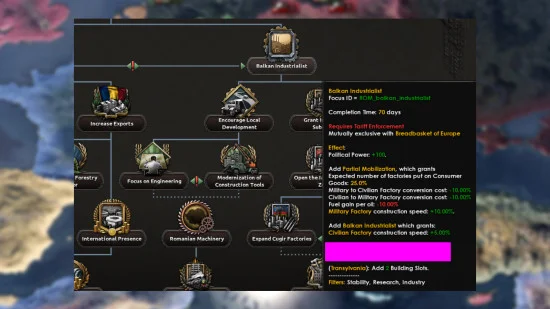
The Balkan Industrialist branch offers a more direct route to economic and military preparation. It’s shorter and gives players early production benefits, with the aim of leaving more attention for diplomacy and military planning. Norrman says Romania can also mobilize its industry in distinctive ways once war begins. The trade-off is that rapid early growth leaves less room to develop the economy’s long-term potential.
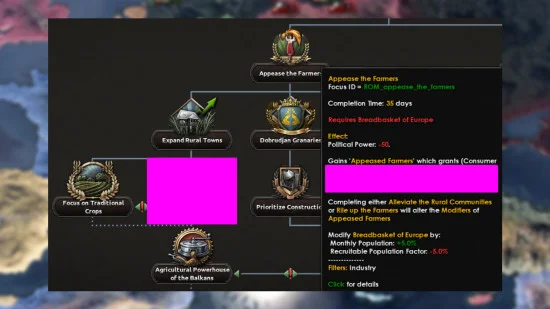
The alternative leans into Romania’s reputation as the “Breadbasket of Europe.” This path asks players to spend more time managing the relationship between farming and economic growth. Paradox hasn’t revealed the major mechanic attached to the branch, though Norrman says it was revised after player feedback.
One confirmed feature lets army recruits return to farm work during peacetime, reducing the friction between maintaining the armed forces and keeping agriculture productive. Players will have fewer free factories, but can earn substantial trade bonuses and additional building slots. The branch also allows more control over the late-game economy, provided the player can invest long enough to realize those gains.
The Romania focus pack has no release date yet. Paradox plans to share more about its alternate-history routes and a military branch that can redirect industry when war breaks out. The wider expansion schedule may take longer: the company says it plans to spend extra time on its next full expansion, while the Romania pack brings a more focused set of new choices in the meantime. For players choosing between immediate industrial strength and a slower agricultural foundation, the key question will be how much time Romania can buy before the wider conflict arrives.