AMD Zen 6c Scores 16.5% Ahead of Zen 5 in Geekbench 7 Test
A 4.1 GHz Zen 6c EPYC scores 2,847 in Geekbench 7, outpacing a similarly clocked Zen 5 chip. Platform differences temper the comparison.
AMD’s Zen 6c has posted a notable single-threaded result in Geekbench 7: an EPYC 9996 sample scored 2,847 points, 16.5% ahead of a Zen 5 Ryzen 7 9700X running at the same 4.1 GHz clock. It’s an intriguing early look at the next CPU generation, but not yet a reliable forecast for desktop Ryzen performance. The chips were tested on different platforms, and Zen 6c isn’t the core design expected in desktop Ryzen CPUs.

A sizable lead at a matched clock
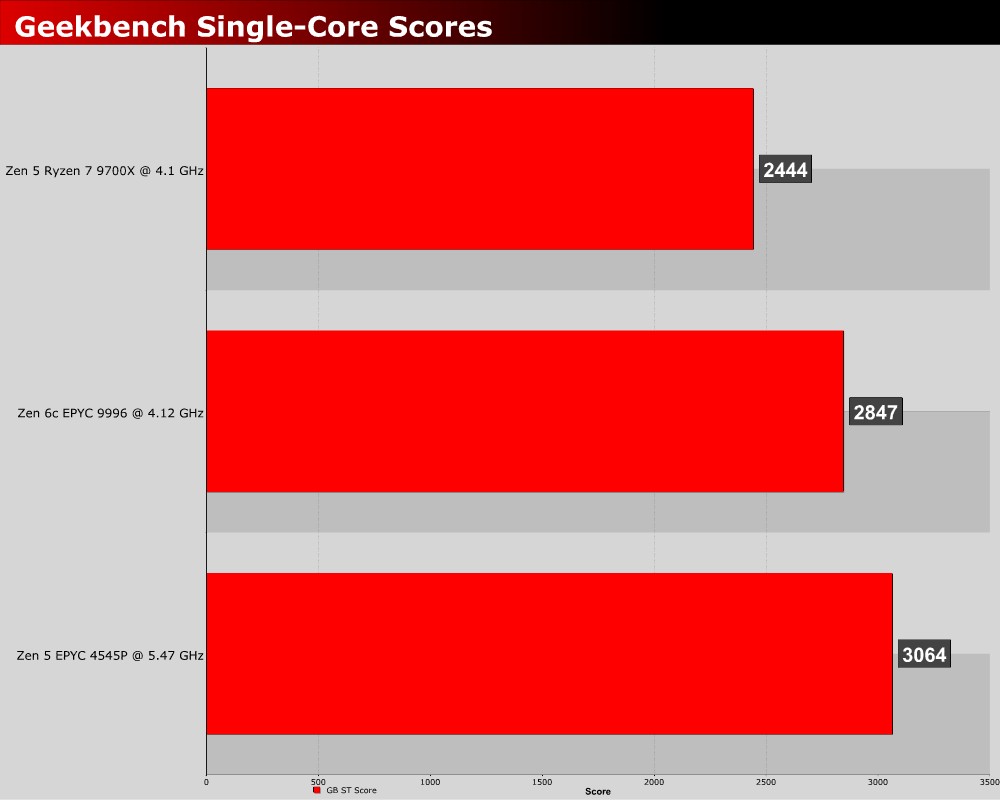
The EPYC 9996 is a 256-core processor with a maximum clock speed of 4.1 GHz. In the reported Geekbench 7 run, its single-threaded score reached 2,847. The comparison point is a Ryzen 7 9700X, an eight-core Zen 5 CPU, also fixed at 4.1 GHz. That chip scored 2,444.
Comparing processors at the same frequency helps isolate the effect of architectural differences, though it doesn’t remove every variable. The Zen 6c result is 16.49% higher in this particular benchmark run. That’s a strong result for a single-threaded comparison, where one core does the work, but it shouldn’t be read as a guarantee that every application will run 16.5% faster.
The results were shared by three twenty six on X, who described the test as an early direct comparison between Zen 5 and Zen 6. Their 9700X was run at a fixed 4.1 GHz, with DDR5-6000 memory and a 2000 MHz fabric clock, using Cachy OS Linux. The reported EPYC score came from a separate system, so the comparison has useful context but isn’t a controlled, same-machine test.
So i guess it's one the first proper Zen 5 vs Zen 6 ST comparisons
My 9700X
@ 4.1 GHz fixed
@ DDR5-6000C34 / auto secondaries / FCLK 2000 MHz
Ran on Cachy OS Linux https://t.co/TShSdtG0aVZen 6 EPYC scores ~16.5% higher in GB7 @ 4.1GHz. https://t.co/fiCWAZY3oq pic.twitter.com/cG5NF3DLL9
— three twenty six (@326powah) October 23, 2026
Results vary across Geekbench’s individual tests
The overall score combines 15 separate tests, and the advantage wasn’t uniform. Zen 6c led Zen 5 by between 8.2% and 25.7% across those workloads. The largest differences appeared in HTML5 Browser, Photo Editor, Structure and Motion, and Video Player. File Compression and Clang showed the smallest gains.
That spread matters more than the headline score alone. Geekbench brings together workloads that exercise processors in different ways, so a large lead in selected tests doesn’t imply an equally large gain in every task. For anyone weighing a future desktop upgrade, the individual results are a reason to watch for broader testing, not a substitute for gaming and application benchmarks on retail hardware.
Clock speed adds another point of comparison
A second comparison puts the Zen 6c result alongside a Zen 5 EPYC 4545P. The Zen 5 processor reached 5.47 GHz and scored 3,064 in Geekbench’s single-threaded test. That score is only 7.6% higher than the Zen 6c EPYC’s 2,847, even though the Zen 5 chip’s maximum clock is 32.77% higher.
Normalising the figures for frequency gives an estimated Zen 6c IPC advantage of about 23.36%. IPC, or instructions per cycle, describes how much work a core completes at a given clock speed. It offers one way to compare core designs, but the estimate here comes from benchmark results across different processors and systems. It shouldn’t be treated as a precise measure of what a desktop Zen 6 CPU will deliver.
What the result can—and can’t—tell Ryzen buyers
The key qualification is the core type. The benchmarked EPYC uses Zen 6c cores, while desktop Ryzen is expected to use Zen 6 cores rather than Zen 6c. These results therefore don’t directly establish the performance of upcoming Ryzen processors. Nor do they answer how many cores those desktop chips will have or what clock speeds they’ll reach; the source provides no such details.
Zen 6c’s result is still encouraging for AMD’s next CPU generation. If desktop Zen 6 delivers similar architectural gains, and AMD can pair them with competitive clock speeds, the result could translate into a meaningful uplift over Zen 5. But the actual outcome will depend on the desktop chips themselves and on the workloads being tested. Gaming performance, in particular, remains unknown from this single-threaded EPYC comparison.
For now, the score is best read as an early sign of stronger per-core performance in Zen 6c, not a desktop performance promise. The next useful evidence will be results from Zen 6 Ryzen hardware tested across games and everyday applications, with platform details clear enough to make comparisons meaningful.
Join the discussion on AMD’s single-threaded performance results on the OC3D Forums.