Manor Lords Update 0.8.117 Adds Manure, Seasonal Crops and a Fishmonger
Manor Lords’ live update adds fertilizer, seasonal sowing, six settlement perks and a new artisan, while changing how fields recover.

Manor Lords’ update 0.8.117 makes farming more involved: players can now collect animal dung, turn it into fertilizer and use it to restore field fertility. The live branch update also splits crops between winter and spring planting, adds a 12-month field calendar, introduces a Fishmonger and brings six development perks to settlements at level three. Together, these changes put more weight on planning how land and livestock support a growing town.

The additions are part of a larger batch of features that had been tested on the beta branch before arriving in the main game. Slavic Magic’s medieval city builder now gives players more ways to manage the connection between pasture animals and crop yields, while asking them to work around planting windows and slower soil recovery. It’s a practical change to the farming loop, with consequences that can play out across several years of in-game production.

Livestock waste becomes a farming resource
Families can take on the new Dung Collector role, gathering dung from pasture animals and bringing it to a new building, the Dunghill. Different animal species produce dung at different rates, making the animals already kept in pastures a source of a useful agricultural input. The collected dung is processed into Fertilizer, and both materials need to be stored at the Dunghill.
That storage requirement gives the building’s placement a small but memorable town-planning wrinkle: players may want to keep it downwind of homes and busy streets. Once Fertilizer is ready, workers at the Farmhouse can apply it to fallow fields. The treatment raises a field’s maximum fertility and supports production for “just over two years,” giving players a way to improve land beyond simply switching which crop grows there next.
This changes the role of fallow fields. Leaving land unplanted now allows its fertility to recover gradually, while fertilizer can boost that recovery’s potential. The update also slows the natural regeneration rate, so the old habit of rotating crop types alone is less effective for long-term sustainability. Players will need to weigh the time a field spends resting against the value of planting it, and consider whether their livestock can supply enough material to help restore it.
Planting now follows the seasons
Crops are now divided into winter and spring varieties. Wheat and Rye suit winter planting, though sowing either in spring offers a quicker harvest with a smaller return. Flax, Barley and Oats are limited to spring. These seasonal rules give the field calendar a more active role: its redesigned view shows the next 12 months of upcoming field activities, helping players plan sowing and harvesting around the year ahead.
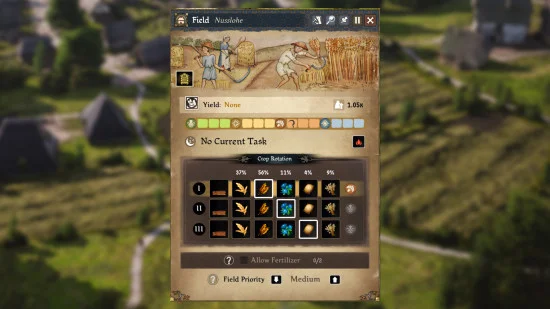
A field with a crop selected but nothing planted now counts as fallow in the simulation, allowing its fertility to rebuild over time. Workers can plow fallow land in spring, summer and autumn, but that work has the lowest task priority. In a busy settlement, that means field preparation may wait while other jobs take precedence.
There’s a new risk for crops left in the ground beyond October, too. Rather than being forced into a rotation, they now start to die gradually. Players get a limited opportunity to harvest what remains, but the yield declines as the crops deteriorate. The change makes an unfinished harvest a decision to manage: other work might be more urgent, but waiting too long can reduce what the fields provide.
New production and settlement perks
The Fishmonger joins the artisan roster, turning Fish and Salt into Smoked Fish. That adds another processing option for settlements with access to those inputs and gives players a new way to develop their food production.
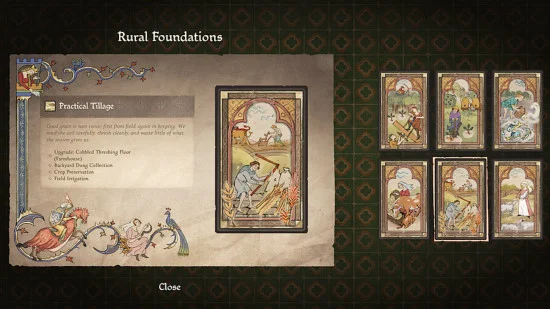
At settlement level three, players can unlock six Rural Foundations perks: Experienced Forestry, Woodland Beekeeping, Fish Husbandry, Livestock Provisioning, Practical Tillage and Pastoral Practice. The update also changes Born of the Alps. It no longer protects sheep from high elevation; instead, sheep produce more wool under those conditions.
More balance changes in the live patch
The farming additions arrive alongside a set of wider adjustments. Crop growth is slightly slower, and fallow fields regain fertility at a reduced rate. Cows and sheep are easier to breed, while the Deep Mine is less efficient. Warbows and crossbows are stronger, and workers collecting and threshing Sheaves now prioritize the grain types in shortest supply.
Slavic Magic says it’s still developing more perks, but prioritized farming improvements based on current Steam Reviews. The update is available now on the live branch as version 0.8.117. For players, the clearest change is that a healthy harvest now depends on more than choosing a crop: planting season, field rest, animal output and the timing of the harvest all feed into the farm’s results. The new calendar should help make those tradeoffs visible before the next season arrives.